
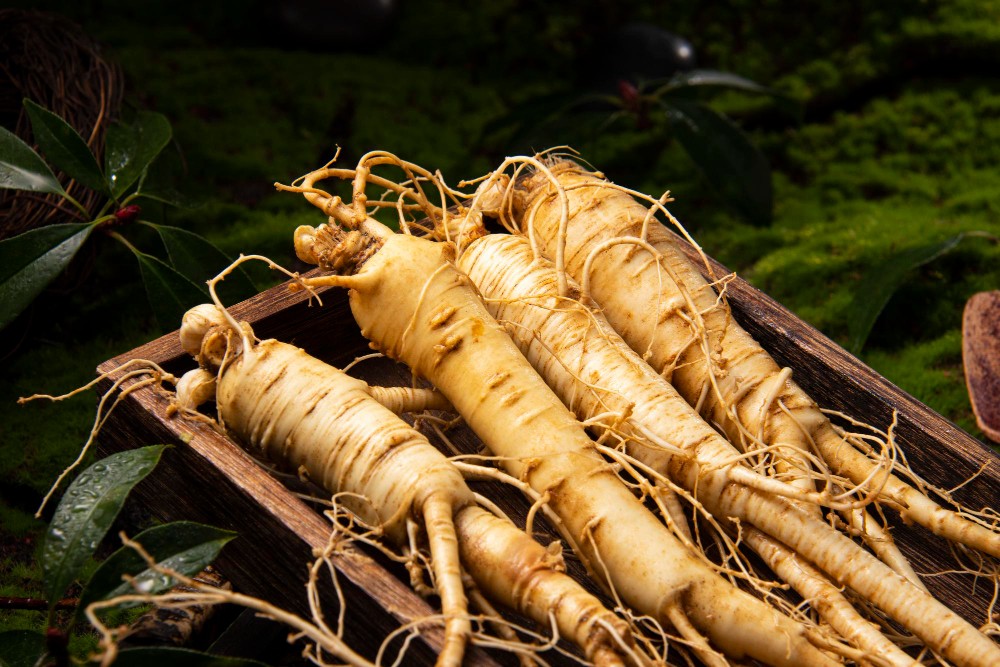
Ginseng is a plant whose roots are used for medicinal purposes. Panax species, in particular, have traditionally been used to treat fatigue, stress, and improve endurance.
The theoretical mechanism of action of ginseng is based on the active compounds called ginsenosides found in its root. These compounds create a multifaceted “adaptogenic” effect by influencing cellular energy production, neurotransmitter balance, immune cell activity, and stress hormones. Therefore, it is expected to have an effect on energy, cognitive performance, immunity, and stress tolerance ( adaptogen = a natural supplement that makes the body adaptable to stressful conditions).
We know the effects of ginsenosides thanks to laboratory experiments, animal models, and human clinical trials. Theoretical mechanisms appear strong in laboratory settings. However, in humans, effects may be weak or inconsistent due to bioavailability, dosage, study design, and individual differences.
Therefore, there is “moderate evidence” for ginseng: some benefits are supported, but it is not clinically conclusive.
Types and Effects of Ginseng
Differences between ginseng species generally stem from their components. Panax ginseng and American ginseng have different ginsenoside profiles; the dominant type of ginsenoside varies in each species, leading to different biological effects. Siberian ginseng, however, does not belong to the Panax species; it contains different components called eleutherosides instead of ginsenosides and is therefore more associated with adaptogenic, stress-managing, and immune-supporting effects.
Panax ginseng (Korean/Asian ginseng)
Effect: Energizing and stimulating effect.
Mechanism of action: It has a high ratio of protopanaxadiol and protopanaxatriol ginsenosides. Therefore, the stimulating and energizing effect is expected to be dominant.
Red ginseng (processed Panax ginseng)
Effect: Traditionally considered more potent due to its steam-processed form. Some studies have reported more pronounced effects compared to white ginseng.
Mechanism of action: Fresh Panax ginseng root is steam-processed and dried. During this process, the ginsenoside profile changes, and new ginsenosides such as Rg3, Rh2, and Rg5 emerge. These compounds have shown more intense stimulant, antioxidant, immunomodulatory, and in some studies, sexual function-related effects.
American ginseng (Panax quinquefolius)
Effect: Balancing and calming effect.
Mechanism of action: It has a high proportion of stabilizing ginsenosides such as Rb1. Therefore, it is expected to have a calming effect on the nervous system.
Siberian ginseng (Eleutherococcus senticosus)
Effect: Adaptogen; stress and immune support
Mechanism of action: It is not a Panax species. It contains eleutherosides. These compounds are mostly associated with immunity and stress adaptation.
Dosages and Durations Used in Clinical Studies
- Panax ginseng (Korean/Asian ginseng)
- Effective dose: 200–400 mg/day (standardized extract, 4–7% ginsenoside)
- Duration of use: 4–12 weeks
- Red Panax ginseng (fermented/processed Panax ginseng)
- Effective dose: 300–600 mg/day
- Duration of use: 8–12 weeks
- American ginseng (Panax quinquefolius)
- Effective dose: 200–400 mg/day
- Duration of use: 4–8 weeks
- Siberian ginseng (Eleutherococcus senticosus)
- Effective dose: 300-1200 mg/day
- Duration of use: 4–8 weeks
Summary
- Doses below 100 mg are generally ineffective.
- 200–400 mg/day Panax ginseng: the range with the strongest evidence.
- Red Panax ginseng: antioxidant and immune-boosting effects at higher doses (300–600 mg).
These data represent dosages observed in studies and are not recognized as “effective doses” by official authorities.
Ginseng and Regulatory Frameworks: US and European Perspectives
Ginseng is an ancient herb that has been used for centuries to increase energy, endurance, and manage stress. However, in the modern world, the marketing and distribution of ginseng are subject to different regulatory rules depending on the region. In the US, the FDA, and in Europe, the EMA/HMPC and EFSA, play a decisive role in this regard.
FDA (USA)
- In the US, all types of ginseng (Panax ginseng, Panax quinquefolius, Eleutherococcus senticosus, etc.) are considered food supplements.
- Permissible language: Statements that support the body’s normal functions are allowed. For example:
- “It supports energy metabolism”
- “It helps manage stress.”
- Prohibited language: Claims regarding the treatment or prevention of disease (e.g., “cures diabetes”, “prevents cancer”) are strictly prohibited.
- Mandatory disclaimer: “These claims have not been evaluated by the FDA. This product is not intended to diagnose, treat, cure, or prevent any disease.”
EMA/HMPC (Avrupa)
- The European Medicines Agency’s Committee for Herbal Medicinal Products (HMPC) has only published an official monograph for Panax ginseng root.
- Status: Traditional Herbal Medicinal Product (THMP).
- Permitted statement: “Traditional use in relieving temporary fatigue and exhaustion.”
- Limitation: Clinical efficacy has not been proven; only long-standing traditional use is accepted.
- Warnings: Usage duration should be short (a few weeks). Not recommended for children, pregnancy, or in combination with certain medications.
EFSA (European Food Supplements Association)
- The European Food Safety Authority (EFSA) has not issued any approved health claims for any type of ginseng.
- Conclusion: Phrases like “boosts energy” or “strengthens immunity” cannot be used on labels or in advertisements. Only general information may be shared, but no health claims can be made on the product itself.